
Revenuecat Meta Ads Masterclass
All the community questions answered

2 weeks ago I ran a Meta Ads Masterclass with RevenueCat and David Barnard. We went an hour over and the chat kept moving the whole time. A lot of good questions never got answered live.
So here they are. One by one. Grouped so you can jump to what’s relevant.
Getting started
“When’s the best point in the app lifecycle to start running Meta ads? Before launch, during, or after some organic traction?” (Jonathan Aranguri)
Depends on your strategy. You’ll need some form of user acquisition. Could be organic social, could be paid, could be something else. Some verticals will be a better fit for a certain channel.
If you identified Meta / paid social as an opportunity I’d rather start sooner than later. Cold discovery traffic coming from shortform video has distinct needs. Testing against that audience from the getgo means you’re actually building a product tailored to it.
“Small indie app, very competitive market. What can we do to run Meta profitably? What’s worth trying, and how much should we invest?” (CryptoCrunchACL)
As an indie developer your main disadvantages are that you’re cash constrained and have less data to work with. (One could also argue that resources and know-how are a disadvantage but building a successful app has never really been about making it elaborate).
Yet you have advantages as well: you can move quickly, have nothing to lose and can work on stuff your competition sees as too small to care about.
Think about specific geos where you have a local advantage and the competition doesn’t focus much. Think about niching down and going deep on a sub audience you’ve identified that is underserved by the competition. Think about how pricing positions competitors and how you can serve audiences that don’t convert at that price.
Don’t try to force your way in through ad spend. It’s just going to hurt and you can’t win in terms of spend levels. What you can win on is qualitative work and creativity.
“For an organically grown app, how do I know which ad platform fits best?” (onurural)
The channel you used to grow the app organically will be a good indicator of where you can advertise. If organic traction already came from TikTok or Instagram reels, that’s a strong signal that you have a decent onboarding and angle that you can amplify through paid. The general presence of organic content relevant to your niche is a good indicator as well.
I’d say Meta is a good starting point for many apps out there. You can make some assumptions based on the nature of your app and the channels used (successfully) by competitors. Consider that it’s a discovery channel people use to distract themselves. Your life will be a whole lot easier if your app isn’t a dry, time-bound use case, like VPNs or taxes.
Creative testing and sourcing
“How do I make ads, and what makes an ad good?” (Or Vinik)
Start with research, not production. Customer reviews, competitor reviews, the subreddits your users live in, the comment sections under ads in your space. That’s where the angles come from.
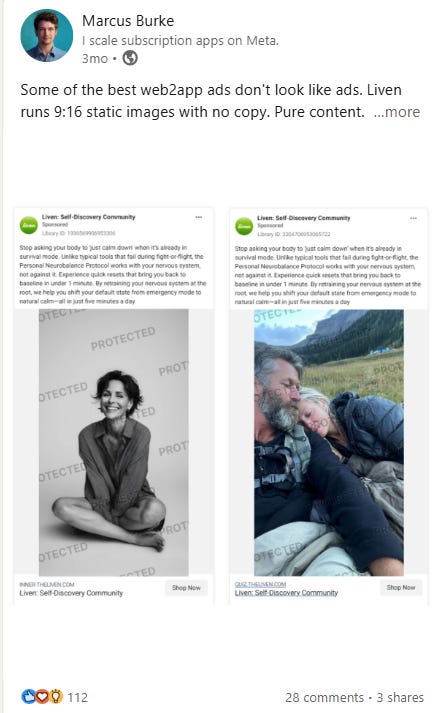
A good ad is content delivered where that content is normally consumed. A talking head goes to Reels. A static goes to feed. Match the format to the placement.
A good ad uses the visual language of the audience you’re looking to target as well as their voice while communicating your message. Further reading:
A non-producer’s guide to AI ad creative for subscription apps

2025 and 2026 have seen rapid, exponential development in AI creative production tools. AI now excels at most formats relevant to ad content. Yet many brands still view AI ads as slop. They’re stuck in 2024 thinking. A lot has happened since.
“How do you organise creative testing? A sheet with angles, hooks, creators? How do you keep track?” (themugooo)
A sheet of angles, hooks and concepts is fine. Document what you learned, not the metric snapshot. Four weeks from now your exact click rate doesn’t matter. The insight about which angle landed with which audience does.
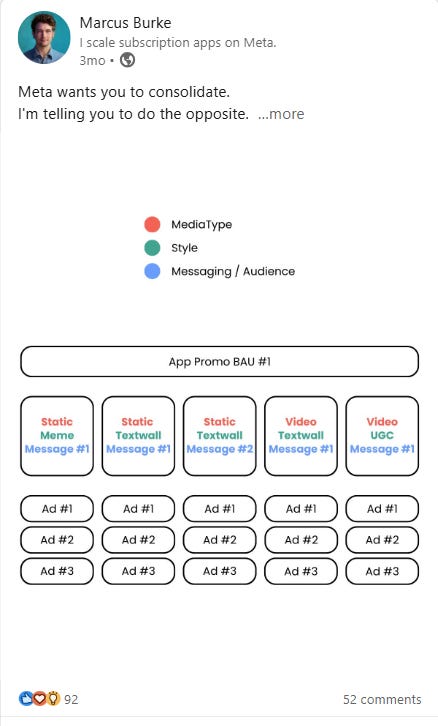
Mechanically: test in a separate campaign, same settings as your BAU but lower budget. Split statics and video (as well as completely different concepts) into their own ad sets so you can read audience and placement-level performance. 3 to 10 ads (iterations) per ad set. Run on a weekly cycle so there’s always fresh input.
“How does minimum spend relate to the number of creatives?” (fahad)
They scale together. You need enough spend per creative to get signal. You need enough creative testing to sustain a scaled spend level as everything always fatigues.
Once an account is up and running, you usually are looking to run creative testing as a ratio of BAU. I tend to aim for 20% test spend while going more aggressive at times.
So at 200k/month you have 40k/month test spend. About 1.3k daily. If your Conversion Event costs you 15-25 bucks you’ll probably want to run a test ad set at 150/daily to allow test ads to gather some signal even when costs are elevated early on. So you’d have 9 ad sets to work with which can hold something like 45-90 ads.
“Should I have creators make UGC for virality, then turn the viral ones into ads? Or dump nearly all the content into ads weekly and let Meta pick?” (Lasheen)
Don’t dump everything and let Meta sort it out. Especially if your Conversion Event is a StartTrial that has 0 business value. You’ll feed the winner-takes-all problem where one ad eats the budget before the others get a fair look.
You want to curate and test in a structured manner. Test in separate ad sets by concept / angle so you can learn. Use organic virality as a signal for which hooks and angles work, then adapt their narrative for paid before you test.
Organic is a great idea pipeline yet viral content is deliberately broad to get you to millions of views. When it comes to paid ads, millions of views with no targeting or clear marketing message are just waste.
“Any platforms you’d recommend for sourcing creators? Billo, FB creator marketplace, etc?” (Jared)
I’ve seen pretty good results with actor marketplaces rather than creator marketplaces. More professional and you’re never paying for someone’s audience / online-fame. For example you can check out Backstage in the US.
I hear Sideshift is the go-to for organic social for apps these days so creators on there should also have a good idea when it comes to making app ads.
Worth flagging: my own creative production is 99% AI-first, so I’m not too deep into creator production pipelines these days.
“What does the feedback loop look like between organic content performance and what you test in paid?” (Lasheen)
Organic shows you what lands with little targeting controls. That’s pure upper-funnel signal: the hook, the angle, the message. Winners become your hypotheses for paid.
Organic mostly ends up broad and relatively young. Paid takes into consideration conversion signal and hence goes after a higher quality and often older audience. So don’t copy-paste. Take the winning angle, then adapt and re-test while applying your paid ads learnings.
Virality / engagement is only half of the equation. While it’s going to improve your quality score and make ads cheaper you also need to bake in a message that converts. Often these contradict.
Structure, scaling and budget
“What’s the best Meta operation for scale? CBO or ABO, tiers, countries, BAU vs testing, horizontal scaling?” (gabepets)
You’ll have to find your own way and likely end up with a mix. What to consider:
In a max volume setup your budget dial is a combination of bid and budget. Increasing budget means Meta bids more aggressively on the backend to spend your budget in full. Hence scaling vertically usually runs into higher costs per event which you have to counteract through ongoing creative wins.
Additionally Meta doesnt have great business context and even when it does will still happily overspend on ads that have great engagement even if they dont perform (e.g. memes).
Hence I combine horizontal and vertical scaling. Horizontal scale is added through ad sets by ad concept / message and layering on web2app and App Promotion campaigns over time. When trying to scale into new geo, I do tier them while using Value Rules to ensure Meta has better context on per-geo value.
I rarely use Advantage+ Campaign Budget as that gives budgeting control to Meta. Even if you try to scale horizontally within that campaign they’re allowed to concentrate spend on just one ad set counteracting my goals.
“How do I scale fast if my ROAS is 1.3?” (ilya)
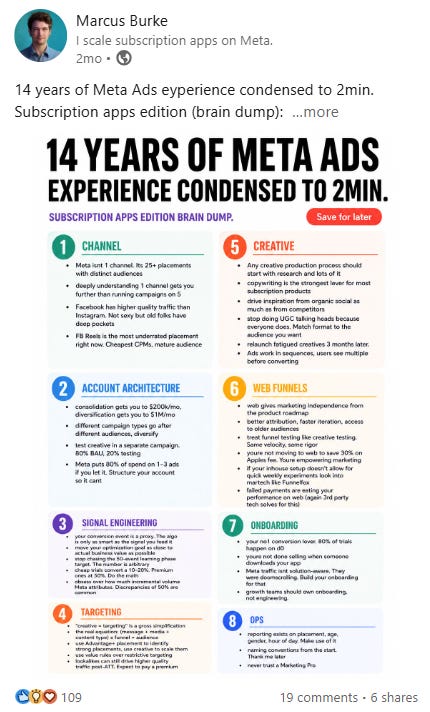
Mostly covered in the section above. Try and expand horizontally as well as vertically while considering new geos and funnels over time.
One thing to keep in mind is that you’re always going to see fatigue on multiple levels. Specific ads fatigue, creative concepts as a whole fatigue, even your funnel and product do as you’re burning through the audience you’re able to purchase at sustainable unit economics.
Hence holding ROAS stable while scaling usually means you need a well-oiled machine that consistently finds winners across every lever to make up for rising CPMs and degrading funnel performance as you push into adjacent audiences.
“At what ROAS would you read it as a signal of underspending?” (Docbeatz)
This would be a very unique number based on your business context. It’s common practice to aim for very thin margins on first purchase. Many apps scale heavily while “only” achieving breakeven with the revenue generated from new cohorts within the first month. Others achieve 30% profit, others are fine with losses until Y1 renewal hits.
Metrics wildly differ based on whether you’re using app or web payments and your growth stage. Just be aware that no one is getting rich on first purchase and it’ll be quite the restriction if you’re trying to.
“I’m at $8 CPI and $40 cost per trial, ~$2,500/month, one ad set, only static images, I shut off the low spenders. What’s the natural next step?” (vincemiller)
First of all never shut off low spenders. They’re not spending anyways so it won’t have an effect on performance other than that you’re resetting the learning phase, which will throw off the big spenders.
Next steps aren’t really dependent on your CPI and cost per trial so they’re hard to define based on the description. A trial can convert at 10% or 60% and can be priced at $40 or $100.
Given that you are only at 2.5k/month I’d assume you’re not making a profit yet. What you want to find out is where your biggest lever sits. It’s usually either creatives or your funnel / pricing.
On the creative side test broadly. Video is clearly a priority. Plus copywriting tends to be a big lever. Identify audiences and the voice to target them as described in my article that I linked above.
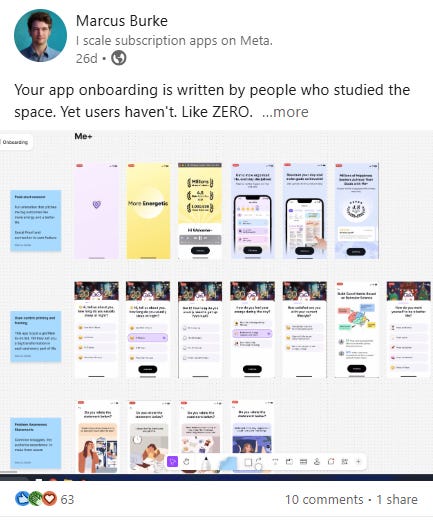
In terms of your funnel, establish a feedback loop quickly to ensure coherence. Your static ads are likely targeting a more affluent audience on premium placements like Instagram and Facebook feed. Always build for an uneducated discovery audience. Your app onboarding should rehook users, get them to problem awareness, build trust and willingness to pay.
“Meta dumps almost all spend on 1 creative out of several after barely testing the others. Do I trust the algo or force spend onto the others?” (mohammed, with Aika)
This is the usual winner-takes-all behaviour. If you want a creative to get a fair shot, give it its own ad set with its own budget. Force the diversification through structure. I would definitely recommend to do so.
You need to put some trust in the algorithm. Don’t force spend onto each and every ad but create meaningful buckets that allow you to learn and the algo to find the best stuff in the right lane. The closer your conversion event sits to actual business value (e.g. a direct purchase) the more you can trust the algorithm.
“How do I move an ad between ad sets or campaigns without losing its learnings or its Instagram engagement history?” (alvin, steveate)
You’ll have to duplicate it using its post ID, either through the Marketing API or by copying that from its URL when you view the ad on Facebook. (While this still wipes the Instagram engagement based on my understanding).
What’s more important though: this ensures that an ad stands a chance when brought from creative testing into BAU where other ads have a lot of engagement.
“How long should I run creative and ad set experiments? Is 3 days the stability point? What’s a good benchmark?” (Aika, asked a few times)
Roughly three days is when the learning phase tends to settle, so don’t read results before that. If conversion events are very scarce, it might take longer. Any change resets it and performance fluctuates while it recalibrates.
“How do I fix scale campaign instability during the week, and a significant drop after 3 days?” (domaskeliuotis)
If performance is severely degraded during the week, you might want to work with budget boosts or schedules (only available when using lifetime budgets). I’ve seen Meta struggling with pacing over and over so I wouldn’t be surprised.
As described above I would actually expect performance to stabilize not drop after 3 days. If it does so, you might have re-triggered the learning phase or the ad set / ads isn’t ready for the scale you’re requesting yet. Which means you’re back to the drawing board when it comes to finding better creative and a better funnel.
Signal, optimisation goals and the algorithm
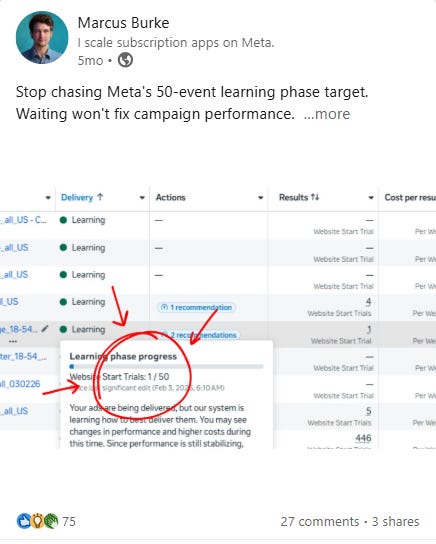
“I can’t hit the 50 purchase events a week Meta wants for a Sales campaign. Should I stick with an Install campaign?” (Bluffgamer)
The 50-event number is arbitrary. Don’t move up-funnel to installs just to clear a threshold, because then you’re training the algorithm on people who install and never pay.
You always want to optimize for a signal with business value. I would rather feed 20 relevant events a week than 100 irrelevant ones.
“Once you have a performing creative, is setting a cost-per-result goal still best practice?” (Jared)
I wouldn’t call it best practice. Most accounts aren’t using cost caps these days. Yet I still see them work at times.
If you are looking to use cost caps make sure the ad set was able to gather a history first, then set the cap 3-5x above the historic Cost per Event, then bring it down from there until it shows effect.
Cost caps will often kill delivery, making them hard to manage, which is why so many accounts avoid them.
“How much can we trust Meta AI and the Marketing Pros? They always suggest spending more to get better results.” (Aika, and the thread with mohammed)
Let’s keep this short: I’d recommend to use these resources given to you by Meta for administrative challenges never for marketing ones.
“What’s the best strategy in the post-Andromeda era?” (ps27)
The Andromeda update has been over exaggerated online from my POV. Free yourself from these hype cycles and invest in the fundamentals. Ads grounded in strong research, optimized for a conversion event with business value. A deep understanding of the channel and audience analytics. Testing and retesting over and over instead of relying on best practices preached by marketers that don’t know your business.
“What’s the typical percentage increase in install-to-paid conversion after the learning phase completes?” (ps27)
Don’t expect a bump after the learning phase finishes. An ad set/creatives will have found their audience after fewer events and stabilize. If Cost per Event flatlines after 20 events, don’t wait for 50 hoping for performance to improve.
Tracking, attribution and measurement
“Just got approved for AppStack. Does EAC change your approach to creative testing or optimisation on Meta?” (StrengthPals)
Not really. Same setup as described multiple times above.
What does change is that web campaigns are better when it comes to distributing diverse creative formats. If you’ve tested statics before and they didn’t work, it’s worth retrying.
“How does attribution accuracy compare between AppStack and a traditional MMP?” (StrengthPals)
That depends on how you’ve been attributing when using a traditional MMP.
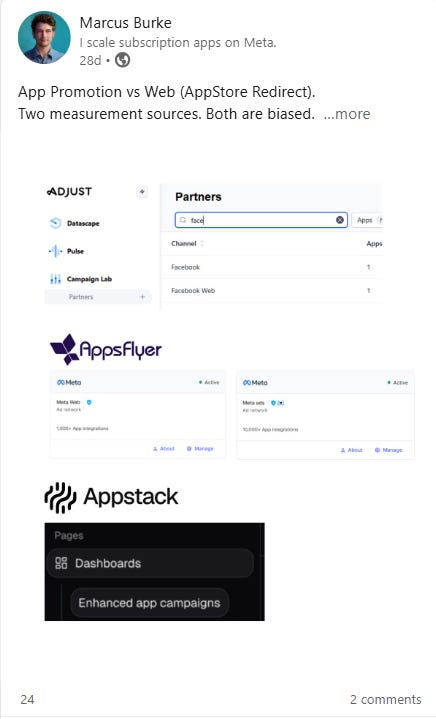
You can set up the same thing Appstack does through any MMP using web campaigns and their deferred deep links. Usually it’s through an additional partner setup called Facebook web or Meta web. I haven’t seen a difference in AppStack vs MMP when both run on that setup.
Make sure to keep an eye on your event match quality in Events Manager. Don’t assume any provider will get you to 100%. You’ll always need to figure out the discrepancy to set your goals.
What does make a difference is moving from AEM-based App Promotion Campaigns to web campaigns tracked through Appstack or an MMP. Web campaigns enable view-through attribution on Meta. AEM is click-through only. View-through rates of 40% are pretty common if you are relying on video ads / Reels placements heavily.
MMPs on the other hand only show click-through for web campaigns yet click + view for App Promotion if you opted into Advanced Mobile Measurement. When trying to figure out which setup actually drives the best results, make sure you’re not purely relying on Ads Manager and standard attribution windows as these will favor AppStack/Web-based campaigns.
“Does coupling Meta Ads with a RevenueCat web funnel address ATT limitations?” (ps27)
Web-based attribution has the advantage of leveraging Facebook click IDs as unique identifiers (on top of IP and device identifiers used in any kind of fingerprinting). So generally a web funnel will have more accurate attribution based on my experience.
The question implies that you’re looking to make a decision on whether to send people to the web or app based on measurement accuracy. I wouldn’t really think about it like that. Web funnels attract different audiences and require different skill set from app funnels. Some apps lend themselves better to one over the other.
Make sure you deeply understand that choice before making it for the wrong reasons.
“What role does tracking, analytics and MMP integration play in success? And do you always get a smooth ride with tracking events? How complicated is your relationship with the devs integrating them, especially small indies?” (Michal Tomcany)
Measurement is foundational, because the algorithm is only as smart as the signal. You want to optimize for an event that happens within 24 hours after install. An MMP isn’t a necessity. You can use the Facebook SDK for free and run ad promotion campaigns. Appstack enables web-based campaigns without an MMP.
The analytics setup on smaller accounts is usually pretty lean. There’s no expensive tool/advantage you can buy that fixes attribution. Learn your way around Ads Manager reporting across demographics and placements. Triangulate using App Store Connect and first-party data gathering and onboarding. For the latter you need to ask relevant questions in onboarding in the first place, like: age, gender, where did you hear about us, goal…
And no, it’s rarely a smooth ride. Yet it’s foundational so you want to take your time to get the event setup right. Potentially testing different approaches like FB SDK, Appstack, MMP early on.
“What’s your preferred tool for tracking onboarding drop-off? Mixpanel, something else? Any tips on setup?” (LifeByPeter)
I prefer Mixpanel simply because I am most used to it. Amplitude does the job. Some developers use Posthog which is cheaper yet harder to work with from my POV.
“When more ad spend lifts total growth but the numbers credit organic, how do we read that, and what do we tell the business?” (solblitzer)
Any positive effect driven by a channel should be attributed to that channel. Otherwise it’s going to be hard to keep growing it. The effect you’re describing partially comes down to view-through. People watch video ads on Meta then go to the App Store and look up your brand name, meaning results land in your search ads brand defense campaigns or organic. If everyone understands that behavior, there shouldn’t be any discussion of which channel to credit. (Simply crediting organic or brand fans is nothing you can act on.)
Yet there’s effects beyond that which are harder to read. Channels drive word of mouth. Channels drive an increase in App Store ranks and hence non-brand organic search. Different channels do this to a different extent. That’s what app developers tend to hypothesize in their attribution models as they grow.
Profitability and economics
“When you say profitable, do you mean day 1, 3, 7, ie when a trial ends, or LTV-profitable? What’s a scalable return on $1 spent at the end of a trial?” (LifeByPeter)
Understand your ROAS at reasonable milestones. If you’re using a 7-day trial, definitely look at day 8 ROAS as your leading indicator. Then understand lag conversion and how a day 8 ROAS builds into day 14 or day 30.
When I say profitable I mean profitable based on first purchase so after your trial converts. LTV:CAC isn’t a metric you or your UA team should deal with. It’s a top-level business one considered when setting goals and planning for longer time horizons.
“I’m at 0.75 ROAS in month 0. I think I can close the gap with a higher annual price. Right call?” (vincemiller)
Pricing is one of your biggest levers. Your trial metrics move heavily with price. Raising the annual price can lift ARPU at the cost of conversion. Make sure you’re getting enough signal in to afford it. Consider your SKU composition (might people start picking monthly or other plans?) and ensure your audience can afford that higher price.
I framed it as placement-price reciprocity before: if you’re running statics on feed, you’re reaching an older, higher-purchasing-power audience, so a higher annual price may well fit. Test it. Just don’t treat price as the only fix. Audience quality and signal matter at least as much.
Product, onboarding and paywall
“How often should we update onboarding and the paywall?” (nikhildhamsaniya)
Your app and web onboarding are the extension of your ads. As creative and audience composition changes over time you’ll want to adapt onboarding. On top it’s very unlikely you already found the perfect one for your current composition.
And you want to test as much as possible. Always have a test running and increase the number over time: narrative, specific mechanics, pricing… The market is always moving and developing a strong first-time user experience built for a discovery channel is a real edge. Don’t underestimate. Onboarding is where it’s at.
Working with clients
“What’s your biggest bottleneck when onboarding clients?” (ossy)
It’s usually creative. Producing diverse creative at scale is hard. Everyone has some kind of pipeline but having found a few working concepts is barely the beginning. Next to ensuring what you have doesn’t fatigue and die, the actual work of a creative strategist is to expand your audience targeting through fresh concepts and angles and then syncing with growth to ensure your onboarding is able to convert these audiences based on the narrative and pricing it sets.
Thank you to everyone who showed up, asked, and stuck around well past the hour. David and I had a blast. More of these to come.
BOSS
Thanks, Marcus! I appreciate this much care for answering all of them!